

Non-ferrous metal machining versus steel machining – key differences and challenges in CNC technology
Every advanced engineering project begins with the selection of materials and ends with a finished, precision-made component. What happens between these stages is professional metalworking – a complex technological process which, depending on the raw material selected, follows completely different scenarios. Why does aluminium milling differ so drastically from stainless steel turning? How does the tool selection strategy affect production costs? In this article, we break down the process of metalworking in a modern tool shop into its constituent parts.
At DWJ Tool Shop, we know very well that there is no single, universal method for effective cutting. Metalworking is a broad concept which, in workshop practice, encompasses dozens of strategies, hundreds of tool types and thousands of variable parameters. In order to achieve the ideal surface, the required tolerance and repeatability of the series, the CNC machine operator and technologist must have a thorough understanding of the physics of the material. Here is a comprehensive comparison of two technological worlds: steel and non-ferrous metal machining.
The physics of cutting – why does the material dictate the conditions?
The basic challenge facing every CNC technologist is the physicochemical specificity of the alloy being machined. Metalworking is, in simple terms, the controlled destruction of material in order to give it the desired shape. However, the way in which the material ‘submits’ to the tool is what determines everything.
Customers ordering CNC services often ask why the cost of producing the same part varies dramatically depending on the raw material. The answer is simple: metalworking is time and energy. The time needed to set up the machine, the time needed for cutting itself, and the rate of wear and tear on expensive cutting tools. Hardness, ductility, thermal conductivity and hardening tendency – these are the four horsemen of the apocalypse in the CNC industry.
Challenge 1: Machining hard metals (ISO P and M groups)
Steel, especially stainless steel (so-called ‘acid steel’) and advanced tool steels, are materials that offer enormous resistance. Machining metals with high hardness and tensile strength generates extreme temperatures in the cutting zone, sometimes reaching 800-1000 degrees Celsius.
Specific characteristics of structural and tool steel
When working with standard steel (e.g. S355) or tool steel (e.g. NC11), metalworking requires rigidity above all else. The CNC machine must be stable so that it does not vibrate when cutting resistance is high. Vibrations are the number one enemy – they destroy the cutting edge of the cutter and cause ‘waves’ to form on the surface of the workpiece.
At DWJ, we use strategies focused on:
- High torque: The machine must have the ‘power’ to break the chip.
- Coated tools: We use carbide cutters and drills coated with special coatings (e.g. TiAlN – titanium aluminium nitride), which act as a heat shield, allowing for stable metal machining at high temperatures.
A technologist’s nightmare: Stainless steel (Inox)
For stainless steel, metalworking is even more difficult. This material has low thermal conductivity (heat does not escape from the chip but accumulates in the tool and workpiece) and a tendency to harden under the influence of crushing. If the tool merely ‘slides’ over the material instead of cutting, the surface instantly hardens, making further work impossible. This requires the operator to adopt an aggressive but confident strategy – metalworking with stainless steel is unforgiving of hesitation.
Challenge 2: Machining non-ferrous metals (ISO Group N)
Moving on to non-ferrous metals, we enter a completely different technological reality. It might seem that since aluminium is soft, its metalworking is trivial and inexpensive. Nothing could be further from the truth. Non-ferrous metals are treacherous due to their plasticity and tendency to ‘stick’.
Aluminium – speed and volume
In the case of aluminium alloys (both wrought and cast), metalworking is a race against time. Here we use HSM (High Speed Machining) technology. The machine spindles spin at speeds of up to several thousand or tens of thousands of revolutions per minute. The main problems are:
- Blade build-up: Aluminium can chemically ‘weld’ itself to the cutter, which immediately destroys the smoothness of the surface and can lead to tool breakage. Therefore, light metalworking requires the use of special polished cutters without coatings to which the material does not adhere.
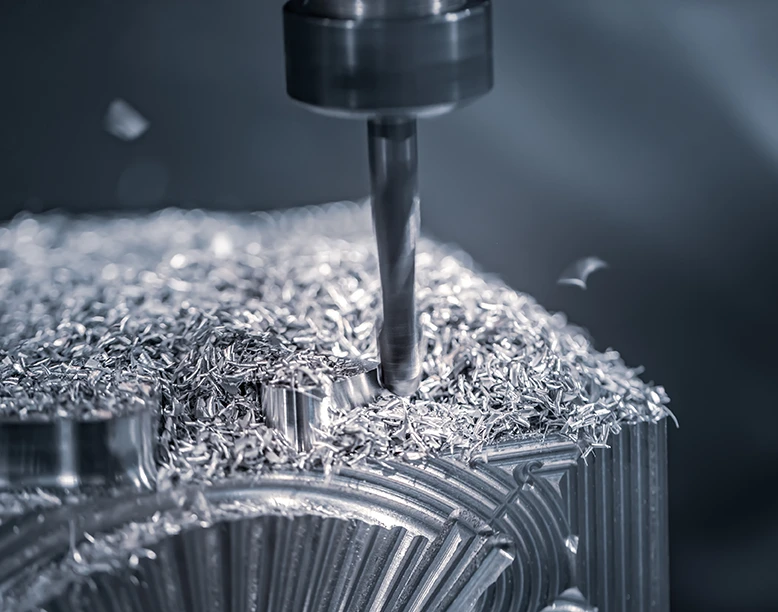
- Chip evacuation: At such high speeds, metalworking generates chips at a rate of one bucket per minute. They must be removed from the work area immediately so that they are not ‘reground,’ which would scratch the perfect surface of the workpiece.
Copper and brass – precision for energy and moulds
Copper is an extremely ductile and ‘sticky’ material. Precise metalworking in the case of copper (often used for deep hole drilling electrodes) requires razor-sharp tools. Any blunting of the edge causes the material to ‘smear’ instead of being cut. Brass, on the other hand, although easier to cut (it produces short, brittle chips), requires caution to avoid tearing the material. In both cases, professional metalworking at DWJ guarantees that tight tolerances are maintained.
Tools and coolant – the technical heart of the process
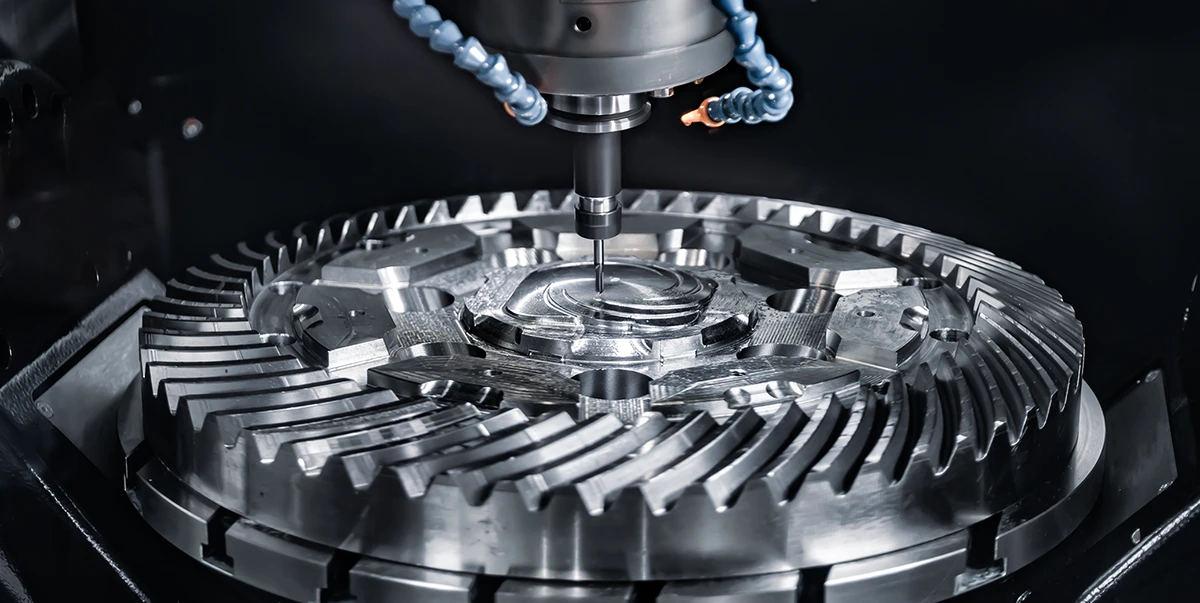
Material differences force us to have a diverse tool inventory. Metalworking cannot be effective if we use the same cutter for everything.
- Blade geometry:
- For steel, we use cutters with 4, 5 or more blades, which increases the stability of the tool core. The rake angles are selected to ensure that the edge is durable.
- For aluminium, metalworking requires 2- or 3-blade cutters with very deep chip flutes. The idea is to make room for the large volume of material being removed.
- The role of coolant:
- For steel, the coolant’s main purpose is to lower the temperature and lubricate.
- With aluminium, metalworking requires high-pressure coolant, the main purpose of which is to ‘flush’ chips out of deep pockets and holes and prevent material from sticking to the tool.
Process economics – how does the choice of material affect the price?
For the end customer, metalworking is an item in the cost estimate. It is worth being aware that the price of the material is only one component. Sometimes cheaper steel is so difficult to machine (low machinability) that the cost of CNC machine man-hours will exceed the savings on raw materials. On the other hand, more expensive aluminium alloys, dedicated to machining, allow for such fast work that the final cost of the part decreases.
That is why at DWJ Narzędziownia we always advise at the design stage. We analyse whether the selected grade is optimal, whether metalworking of a given type will generate unnecessary costs, and whether it is worth replacing the material with one that, while maintaining the strength parameters, will be easier to produce.
Why is experience in metalworking crucial?
At DWJ Narzędziownia, metalworking is not just about mechanically running a programme written by a CAM system. It is primarily about choosing the right technological strategy. Mistakes at the process planning stage are costly. The wrong choice of parameters for stainless steel can harden the surface so much that the part ends up as scrap. Poor cooling with aluminium can destroy a batch of material by jamming the chips.
Our experience allows us to avoid these pitfalls.
Metalworking as we do it is a predictable, repeatable and safe process for the material entrusted to us.
Comprehensive metalworking at DWJ – your advantage
Whether you need a complex aerospace aluminium body, a precision copper electrode or a hardened tool steel injection mould component, we are ready to take on the challenge. Metalworking is our passion and our daily work, in which we strive for perfection.
We understand the nuances of materials. We know how metal behaves under the influence of temperature and cutting forces. We are able to select a process that is economically viable for the customer and technically feasible with the highest precision. If you are looking for a partner who can handle both hard steel and demanding copper, please contact us. See how modern metalworking at DWJ Narzędziownia can improve your production and increase the quality of your products.